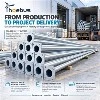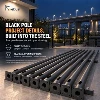

Hot-dip galvanizing is the cornerstone for long-lifespan street light poles, delivering robust anti-corrosion performance for municipal roads, solar street light projects, high mast towers and smart city lighting infrastructure. Many manufacturers focus only on the zin-immersion procedure, yet inadequate pre-galvanizing fabrication and surface work will trigger peeling coating, bare un-zinc-covered spots, blistering or hidden structural risks, raising rework costs and shortening the pole's service life. For street-light steel poles made of Q235B or Q355 steel, several critical tasks must be fully finished prior to sending components to the galvanizing bath.
Complete Full Fabrication Work Before Galvanizing
All cutting, rolling, welding, punching, drilling and assembly-related machining shall be 100% completed before hot-dip galvanizing.

Any cutting, drilling or welding performed after galvanizing will destroy the formed zinc alloy layer and require complicated touch-up repair, which cannot match original metallurgical bonding quality.
Finish forming of pole shaft, base flange plate, handhole openings, lamp-arm mounting brackets and anchor bolt holes.
Pre-fabricate access doors and reinforcing ribs; avoid post-galvanizing welding reinforcements.
Thread processing for bolt connections must be done ahead of galvanizing, with thread protection measures in place to prevent zinc accumulation blocking threads.
Weld quality control is especially vital. Weld seams need to be continuous and compact without blowholes or hidden crevices. Porous gaps trap acid liquid during pickling, later oozing out and creating coating defects. Welding spatter, slag and residual flux from welding electrodes must be chipped, brushed or ground away thoroughly. Ordinary acid pickling cannot dissolve welding slag, and leftover slag will leave black uncoated patches on finished poles.


Design & Machine Vent and Drain Holes
Street-light poles are hollow closed steel structures. Without properly arranged vent and drain holes, high-temperature thermal expansion of trapped internal air during zinc immersion may even cause safety hazards. Meanwhile, cleaning liquid and molten zinc cannot flow freely inside cavities, resulting in zinc pooling, uneven coating and residual chemical solution trapped inside the tube body.
 Vent and drain openings shall be cut at proper corners or end positions of the pole body, complying with structural drawing requirements, without weakening overall mechanical strength and wind-resistance performance. For tapered conical poles, drainage holes are normally arranged at the smaller-diameter end. This step applies not only to conventional road lighting poles, but also to solar street light poles, decorative light poles and high-mast poles with large hollow sections.
Remove All Hard-to-Treat Surface Contaminants
Galvanizing plants carry out degreasing and pickling chemical treatments, but some stubborn pollutants cannot be eliminated by acid-bath processing alone. These contaminants block metallurgical reaction between molten zinc and steel substrate, leading to local coating failure.
Before delivery to galvanizing factory, manufacturers should clear away:
Cutting fluid, machine oil, grease and anti-rust oil from steel plate processing;
Residual paint, silicone adhesive, sticker glue and oil-based marking crayons; use water-soluble marking paint or steel stamping for layout marks instead;
Heavy mill-scale, sharp burrs and jagged cutting edges; chamfer sharp edges to avoid excessively thick zinc build-up or cracking at sharp corners.
Pre-Inspect Steel Substrate and Mark Lifting Points
Check base steel material consistency. Different silicon and phosphorus content in steel will influence final zinc-coating thickness and surface appearance. For coastal, high-salt-fog tropical projects, confirm steel grade in advance to match expected anti-corrosion target before galvanizing production.
Define lifting and hoisting positions for the street-light pole. Lifting lugs or suspension points need to be set on non-visible secondary surfaces. Random hoisting on main exterior surfaces will leave bare contact marks after galvanizing, affecting appearance and anti-corrosion capacity. Record these hoisting positions in internal production checklists for workshop operators.
Pre-Checklist Confirmation Before Hand-over to Galvanizer
Before transporting fabricated street-light poles to galvanizing workshops, technical teams should run a final checklist:
✅ All mechanical fabrication, welding and grinding work is finished
✅ Vent & drain holes are machined at correct positions
✅ Weld slag, burrs, oil, paint and stubborn surface pollutants are removed
✅ Threads and precision mounting holes get proper protective treatment
✅ Hoisting positions are designated to avoid damaging visible outer surfaces
✅ Steel material matches project specification for working environment
Only when all above items pass inspection can poles enter degreasing, rinsing, pickling and flux treatment stages of galvanizing workflow.
At Phoebus Lighting, every street-light pole, solar lamp pole and high mast pole strictly implements this pre-galvanizing inspection system. Our in-house rolling, welding and grinding workshop completes all fabrication procedures before galvanizing, which guarantees hot-dip galvanizing quality, supports over 20-year anti-corrosion service life for outdoor lighting projects across municipal, rural, airport and stadium scenarios.
Poor pre-galvanizing preparation brings hidden risks that cannot be offset by better zinc-bath parameters. Standardized pre-work lowers project rework rates, stabilizes pole quality and delivers higher value for global lighting buyers.