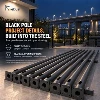

As a core component of urban road infrastructure, powder-coated octagonal street poles are widely adopted for their stable structure, strong wind resistance and excellent anti-corrosion performance. The polyester powder coating on the pole surface serves as the primary barrier against ultraviolet radiation, rain erosion, oxidation and mechanical wear, directly determining the service life and operational safety of street poles. Industry inspection experts emphasize that random coating thickness testing cannot guarantee engineering quality. Only standardized fixed-point detection can ensure uniform coating performance and meet national and international infrastructure construction standards.

Powder coating thickness is a key indicator for evaluating the surface treatment quality of octagonal street poles. Qualified poles usually have a standard powder coating thickness ranging from 60μm to 100μm, matched with a hot-dip galvanized base layer of no less than 85μm, forming a dual anti-corrosion protection system. Uneven or substandard coating thickness will lead to premature peeling, rusting and fading of the pole surface, resulting in shortened service life and increased urban infrastructure maintenance costs. Therefore, accurate fixed-point thickness detection is an essential link in factory inspection, project acceptance and routine maintenance.

Professional inspection specifications clarify three core priority detection areas for powder-coated octagonal street poles, covering stress concentration, vulnerable and key structural parts. The first key detection area is the middle main body of the pole. As the largest surface area of the octagonal pole, this part bears long-term outdoor ultraviolet exposure and wind and rain erosion. Eight angular edges of the octagonal structure are prone to thin coating and uneven spraying during electrostatic powder spraying. Inspectors need to sample and test each side of the middle section to ensure the coating thickness meets the 60–100μm standard and avoid local missing coating or insufficient thickness.
The second crucial detection position is the pole bottom 0.5–1.5 meters above the ground. This area is most vulnerable to damage in daily use, affected by road water splashing, dust friction, pedestrian and vehicle collision. It is also the key area for corrosion deterioration of street poles. In actual production and spraying, the pole bottom is prone to coating accumulation or insufficient adhesion. Thickness detection here focuses on verifying coating uniformity and bonding firmness to prevent bottom rust penetration that endangers the overall structural stability of street poles.
The third mandatory detection area is the welding joints and component connection parts, including lamp arm connections, flange welding positions and pole body splicing joints. Welded parts have rough surfaces and complex structures, making them difficult to spray evenly and prone to coating defects such as pinholes and thin layers. These hidden defects are easy to induce local corrosion and spread outward. According to GB/T 13912 and municipal road lighting inspection standards, all welding and connection nodes must be tested one by one to ensure the coating thickness covers the base metal completely without dead angles.
Industry quality supervisors remind that scientific detection methods are equally important besides fixed-point testing. Inspectors shall use professional coating thickness gauges for non-destructive testing, conduct multiple groups of sampling tests on each key position, and record average data to eliminate detection errors. For newly installed street pole projects, full coverage inspection of key points is required before acceptance; for in-service poles, regular spot checks every year are needed to track coating aging and thickness attenuation.

In conclusion, targeted thickness detection on the middle pole body, bottom vulnerable area and welding connection parts of octagonal powder-coated street poles is the core guarantee of infrastructure quality. Standardized fixed-point inspection can effectively eliminate unqualified products, ensure the long-term anti-corrosion and weather resistance of street poles, and lay a solid foundation for the safe and stable operation of urban road lighting systems.