

How Do Smart Street Poles Generate Revenue?
Aug 26, 2025
Leave a message
As a new type of urban public infrastructure, the full realization of the value of smart streetlights requires a large-scale deployment and substantial, long-term, and sustainable capital investment. The more application scenarios they cover, the greater their commercial value.
 Phoebus smart poles are made of high-strength, corrosion-resistant steel, suitable for installation in multiple scenarios. They can integrate over 10 functional modules, including 5G base stations, environmental monitoring, and video surveillance, ensuring strong compatibility. Our exceptional customization capabilities allow us to tailor the design and functional configuration to meet customer needs (e.g., municipalities, parks, and scenic areas), enabling rapid response to personalized orders. Our comprehensive service system provides a full-process service from solution design and manufacturing to installation and commissioning, and after-sales maintenance. Our after-sales response time is ≤ 24 hours, ensuring stable equipment operation and helping customers efficiently implement smart lighting and smart city projects.
So how do investors recoup their substantial investment? First, it depends on the product's functionality. Overall and over the long term, smart street poles will generate revenue from a variety of operating sources, including subsidies, installation, operation and maintenance, onboarding, advertising, energy, base stations, and data.
1. Main Maintenance Revenue from smart street poles
This revenue primarily refers to situations where the government invests solely in and entrusts enterprises with operation and maintenance, including repair and maintenance revenue.
2. Energy Savings from Smart Lighting
For smart streetlight projects invested in by enterprises, the government will subsidize the electricity savings in installments.
3. Rental Revenue from Video Surveillance
This revenue primarily refers to rental revenue paid by public security and transportation departments after the light poles are connected to the Skynet and security systems.
4. Micro Base Station Rental Revenue
This revenue category refers to the rental revenue paid by operators for mounting 5G micro base stations on light poles.
5. Charging Station Revenue
After smart street poles are equipped with charging stations, consumers will pay corresponding charging fees when using them.
6. Parking and Manhole Cover Management and Other Management Revenue
Since smart street poles can monitor road parking conditions and the operation and maintenance of road manhole covers, enabling intelligent transportation, they can earn management revenue from transportation departments or other relevant entities.
7. Revenue from Convenient Services such as One-Click Alarm
It should be noted that the generation and collection of expenses for this revenue category is currently unclear. Specific projects may also include one-click alarms as a public welfare feature without generating this revenue category. If this revenue category exists, it is generally paid by the civil affairs department to the investor and operator of the smart street pole.
8. Advertising Revenue from LED Displays and Other Services
This revenue category is relatively easy to understand. In practice, it is also one of the main sources of income for the investor and operator of smart street poles. It is paid by the entity that places advertisements, which are mostly businesses, but also governments and other institutions.
9. Data Collection Revenue
This data includes environmental monitoring data, as well as other non-privacy and de-identified data accumulated during operations. The payer for the former is primarily the environmental department, while the latter is paid by users who receive the de-identified data.
10. Other Revenue
In addition, revenue from connected vehicle services, lamp installation and installation, and body temperature measurement cameras can also generate profitable returns.
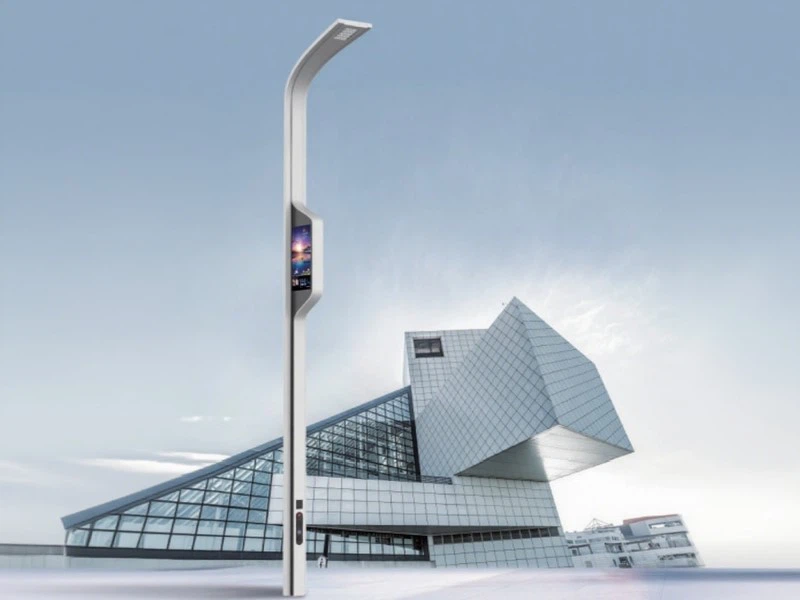
Smart street poles can generate profits in many ways, but it should be emphasized that this actually places very high demands on operations.
Whether adopting the EMC operating mechanism, the PPP model, or the innovative EMC+PPP financing method, the market and government departments should work together to explore top-level designs to ensure that "smart led street poles" become a contributing factor to the development of the Internet of Things, smart cities, and 5G, rather than redundant infrastructure.