

How To Coordinate Ip65 High Mast Lights With Lighting Fixtures?
Mar 04, 2026
Leave a message
IP65 high mast lights not only provide illumination but also serve a decorative purpose, making them an indispensable lighting fixture in many public places. There is a certain knowledge involved in selecting high mast lights; only with this understanding can high mast lights be used appropriately.
1. When matching high mast lighting fixtures, the first step is to choose the core, which includes the type of light source and distribution.
Nowadays, LEDs are the most popular light source for high-mast lighting. They can save a substantial amount of energy while fulfilling the majority of outdoor lighting requirements thanks to their luminous efficacy of 130–180 lm/W, color rendering index Ra of 70–90, and lifespan of over 50,000 hours.
2. The secret to guaranteeing lighting effects is creating targeted matching schemes based on various application scenarios.
Six to twelve 200–400W LED floodlights are typically combined with 15–25m electrically powered high-mast lights for city squares and key intersections. When the color rendering index (Ra) is greater than 70 and the color temperature is regulated between 4000 and 5000K, batwing or symmetrical light distribution is employed. The requirements for large-area lighting are met without sacrificing visual comfort.
On highways and interchanges, glare control and high-mast light height regulations are stricter. Mainlines usually use 8–12 300–400W LED lights with 30–40m high-mast lights, using asymmetrical or cut-off light distribution. Ramps and service areas use 20–25m high-mast lights in addition to 6–8 200–300W LED lights to guarantee driving safety. Both the illuminance uniformity and the glare value (TI) must be at least 0.4 and less than 15, respectively.
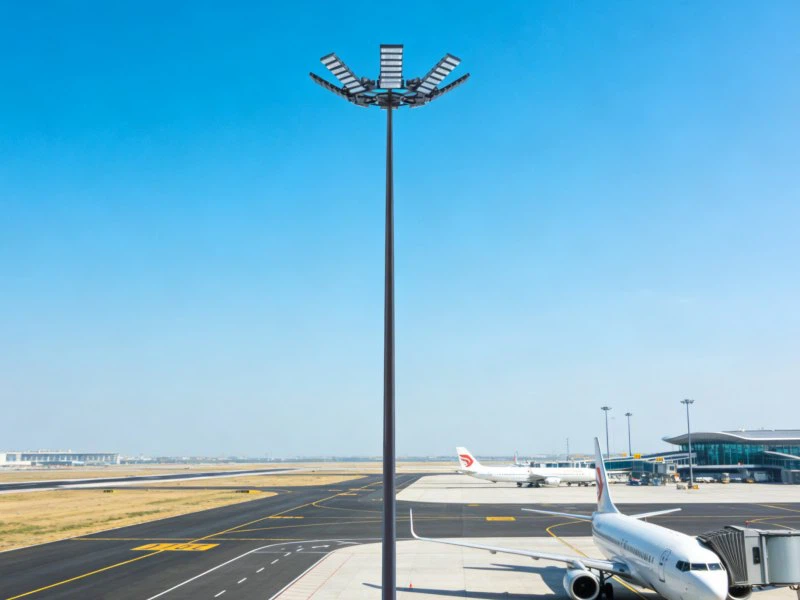
15m 20m 25m 30m high mast light poles Requirements:
1. One-piece construction is required for high mast lighting poles. Welded sections should be as smooth and level as possible, with an error of no more than ±1 mm between protruding parts and the pole body's flatness. It is recommended to use active argon arc welding, and when examined with specialized equipment, the welding must meet international standards. It is recommended to use wire and nails for fixation when splicing the poles.
2. The poles must undergo hot-dip galvanizing for corrosion protection. The galvanized layer should be flat, smooth, and glossy, with consistent coverage on both the shaded and sun-facing sides, free from peeling, drips, zinc nodules, wrinkles, etc. According to national standards, the coating thickness should be higher than 85μm, and the adhesion, wind resistance, and corrosion resistance life of the zinc layer must also meet national standards.
3. The design of IP65 high mast light poles should facilitate wiring connections in addition to complying with anti-slip and anti-theft regulations.
The lifespan of a light pole should be at least 20 years, and its manufacturing procedure and acceptance standards must follow national guidelines.
4. The pole's surface must be covered with a full polyester powder coating that is at least 2H hard and thicker than 100μm. Level, smooth surfaces are ideal. Making sure the pole can survive challenging outdoor conditions is the primary goal.
Lighting installations that are higher than fifteen meters are classified as IP65 high mast lights. They require a one-time investment because they are among the most expensive outdoor lighting installations. High mast lights are expensive, so choosing them requires extra care. Quality is more important than price when purchasing such large streetlights. Structural flaws could have catastrophic effects for such enormous structures that are tens of meters high. Wholesale inquiries are welcome at Phoebus, which has many years of manufacturing experience.