

How to Verify Street Light Pole Dimensions Before Shipment
Sep 18, 2026
Leave a message
Street light poles are standardized infrastructure products whose dimensional accuracy directly affects on-site installation efficiency, structural stability, and overall project quality. Before factory shipment, comprehensive dimension verification is an essential final procedure to eliminate unqualified products, avoid on-site assembly failures, and ensure the poles meet design specifications and industry standards. Complete pre-shipment street light pole dimension verification mainly covers basic size measurement, structural parameter inspection, hole position accuracy check, and overall flatness verification.
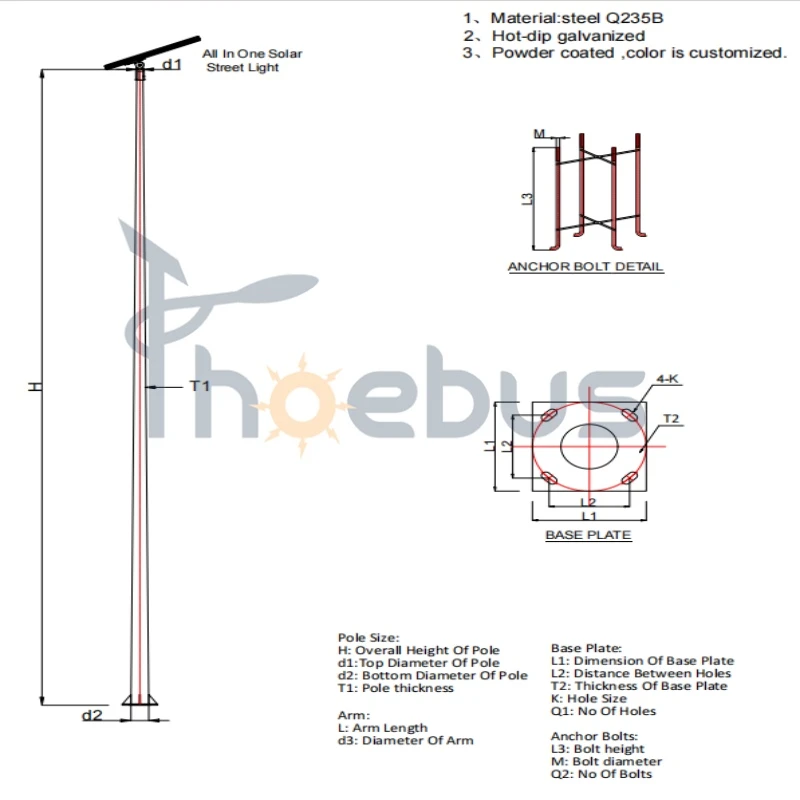
First of all, inspectors must verify the basic geometric street light pole dimensions, including total height, pole diameter, wall thickness, and taper. Different road scenarios require poles of different specifications, and any deviation will lead to inconsistent installation height and uneven lighting effect. Using professional tools such as precision tape measures, vernier calipers, and laser rangefinders, workers conduct multi-point sampling measurements on the pole body. For tapered poles, it is necessary to check the diameter of the top, middle, and bottom sections respectively to ensure uniform taper. All measured data must be compared strictly with design drawings, and any dimension exceeding the allowable error range is marked as unqualified.
Secondly, structural dimension verification focuses on the base flange and welding connection parts, which are key to stable installation. Inspectors check the flange diameter, bolt hole spacing, plate thickness, and perpendicularity between the flange and the pole body. If the flange is inclined or the bolt holes are offset, the street light pole cannot be securely fixed to the foundation, resulting in shaking and poor wind resistance after installation. In addition, the size of the lamp arm mounting position and reserved cable holes need accurate inspection to guarantee the smooth installation of lamps and wiring construction on site.
Flatness and straightness detection is also indispensable in pre-shipment inspection. Bent or distorted pole bodies will not only affect the aesthetic appearance but also cause unbalanced stress and reduce service life. Inspectors use straight rulers and laser level meters to detect the overall straightness of the street light pole. For bent parts, the bending deviation must be controlled within the national standard range. Meanwhile, surface flatness is checked to exclude irregular deformation caused by processing errors or extrusion damage during production.
Finally, all verification data needs to be sorted out and recorded in detail to form a complete inspection report. Unqualified products shall be returned for correction or scrapped, and only poles that pass all dimension tests can be packaged and shipped. In conclusion, rigorous pre-shipment dimension verification is a crucial barrier to street light pole quality control. It effectively avoids subsequent construction rework and economic losses, and ensures the safety, stability, and standardization of urban lighting infrastructure.