

How to Select Anchor Bolts for Street Light Pole Foundations
Sep 22, 2026
Leave a message
Street light pole anchor bolts are invisible yet mission-critical components buried inside concrete foundations for street-light poles. Many global lighting projects focus heavily on lamp performance, pole surface finishing and luminaire parameters, while overlooking street light pole anchor bolt specification. Improper anchor-bolt selection can result in pole tilting, foundation pull-out failure, or even complete pole collapse under heavy wind. Once problems appear on-site, rework costs are extremely high, including concrete breaking, re-pouring foundations and project schedule delays.
With more than 25 years of outdoor lighting manufacturing and exporting experience, Phoebus Light has delivered street-light poles and high-mast poles to over 126 countries. Our engineering team has witnessed dozens of project failures caused purely by poorly-specified street light pole anchor bolts. This article breaks down practical factory-oriented guidelines for selecting anchor bolts for street light pole foundations, helping international buyers and contractors avoid common engineering pitfalls.
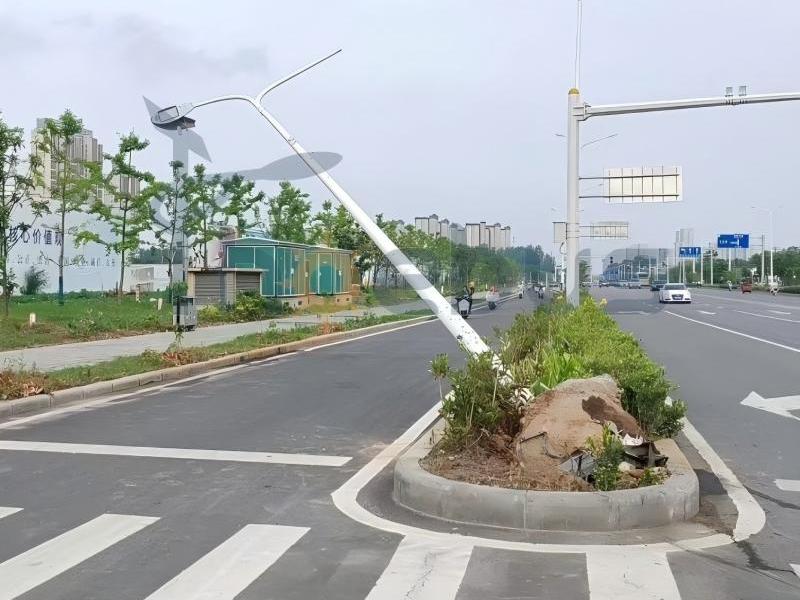
Core Factors That Decide Anchor Bolt Specifications
Anchor bolt size, grade and configuration should never be chosen only according to pole weight. Wind-induced overturning moment acts as the dominant load for tall lighting poles, following international standards including EN 40, ASCE-7 and AS/NZS 1170.2. Four key dimensions must be evaluated before finalizing bolt drawings.
1. Wind load and effective projected area (EPA)
Calculate total wind-exposed surface area, combining the pole shaft, lamp fixtures, brackets, cross-arms, solar panels and extra smart-city accessories. For coastal, typhoon-prone or desert high-wind zones, overturning moment rises sharply, requiring higher-strength or larger-diameter anchor bolts.
2. Pole height and base-flange geometry
6-12 m standard street-light poles and 15-30 m high-mast poles carry completely different foundation requirements. The bolt-circle diameter of the pole base flange must perfectly match anchor-bolt layout. Mismatched hole spacing will make on-site installation impossible.
3. Local site environment
Soil condition: Soft clay, sand and loose fill soil require deeper embedment depth for street light pole anchor bolts. Rock-ground locations demand special anchoring solutions.
Corrosion risk: Coastal sites with salt-fog atmosphere accelerate metal corrosion; ordinary galvanized bolts will degrade much faster near seashores.
Seismic zones: Extra safety margin should be reserved for seismic-active regions.
Local municipal building codes: Different markets enforce distinct requirements. EU projects refer to EN 40, North America follows ASCE-7 / AASHTO, while Middle-East and African projects often adopt modified specifications according to tender documents. Always align anchor-bolt parameters with local code requirements.
4. Critical Technical Parameters of Street-Light-Pole Anchor Bolts
1. Material Grade and Anti-Corrosion Treatment
Q235/Q355 steel anchor bolts
Hot dip galvanized anchor bolts
2. Anchor-Bolt Types: L-bolt, J-bolt and Anchor-Plate Bolt
L-shaped anchor bolt: Widely used for standard 6-12 m street-light poles, balanced cost and pull-out resistance.
J-shaped hook bolt: Offers superior anti-pull-out performance, suitable for typhoon-exposed sites.
Anchor-plate headed bolt: Preferred for heavy-duty high-mast poles; the welded steel plate distributes force across concrete and greatly reduces breakout risk.
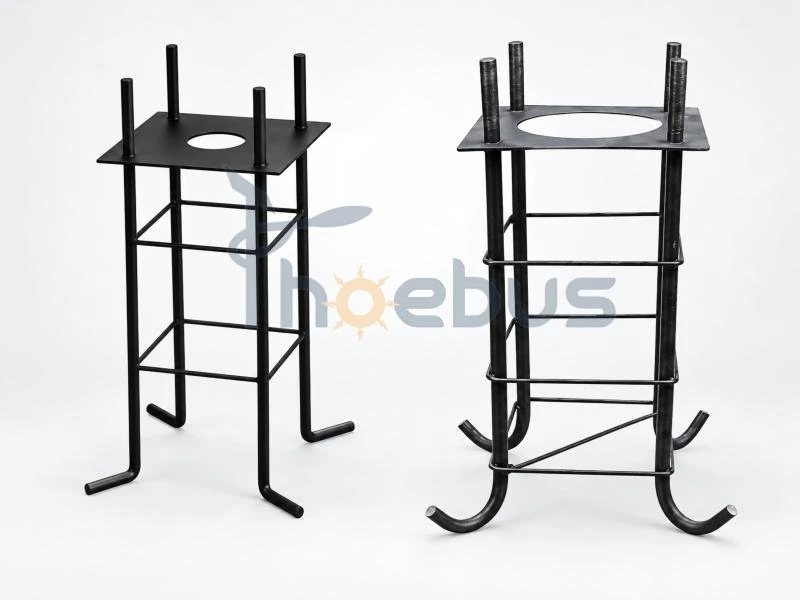
3. Diameter, Quantity and Embedment Depth
General practical reference:
6-12 m street-light pole: M20-M24 bolts, 4-8 sets;
15-20 m high-mast pole: M27-M36 bolts, 8-12 sets.
The minimum embedment depth shall reach 12 times bolt diameter. The hook or anchor plate end must be fully buried within concrete. Too-shallow embedment causes pull-out failure: the concrete foundation remains intact, yet lighting pole anchor bolts are ripped out under wind load.
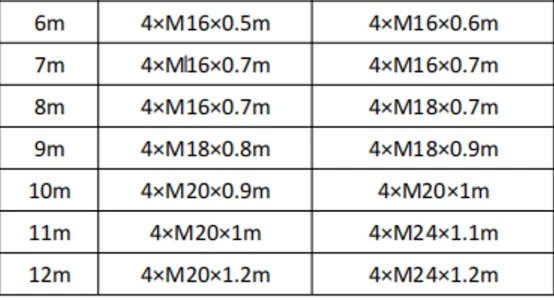
4. Thread Projection Length
The exposed thread length above finished concrete surface must be long enough to accommodate the pole flange, flat washers and double nuts, while reserving small margin for pole vertical adjustment.
Too-short exposed thread: cannot fully fasten nuts;
Excessively long exposed thread: vulnerable to atmospheric rusting and mechanical impact damage.
Most-Frequent On-Site Mistakes With Anchor Bolt Selection
These recurring errors come from real-world overseas project cases handled by Phoebus Light's engineering department.
1. Only calculate pole self-weight, ignore wind overturning moment.
Wind lateral force creates most of the tipping stress for lamp poles. Pole dead-weight provides only limited anti-tipping contribution. Many foundation failures originate from this miscalculation.
2. Mismatched bolt-circle diameter.
Clients revise lamp-pole flange dimensions but forget to update anchor-bolt drawings. After concrete pouring, lighting pole anchor bolt positions do not line up with flange holes, resulting in full-batch rework.
3. Skip positioning template.
Without matched positioning templates, anchor-bolts shift and deviate during concrete pouring, even if bolt specifications are fully correct.
4. Adopt single-nut fastening.
Long-term wind vibration can gradually loosen single nuts. Double hot-dip-galvanized nuts together with flat washers are compulsory for street light pole foundations.
5. Low-grade concrete foundation.
Even high-strength lighting pole anchor bolts will fail if embedded inside low-strength concrete. Minimum C25-C30 concrete grade is required for street light pole foundations.
Complete Foundation-Matching Engineering Support From Phoebus Light
Many lighting manufacturers only deliver finished lamp poles without providing anchor-bolt construction drawings. This creates huge technical pressure for overseas contractors.
Benefiting from our in-house team of 8 engineers inside the 62 000 m² production workshop, Phoebus Light can deliver complete anchor-bolt drawings customized to your project parameters: local maximum wind speed, soil report, pole height and flange dimensions.
We supply optional full anchor-bolt kits including L-bolt / J-bolt / anchor-plate bolts, matched hot-dip-galvanized nuts, washers and positioning templates. Third-party inspection agencies such as SGS are welcome to perform dimension and coating pre-shipment inspection for anchor-bolt sets. Our CAD drawing service can help your local construction team avoid costly street light pole foundation mistakes before concrete pouring.
Conclusion
Anchor bolts represent the invisible safety backbone of every street light pole foundation. Choosing lighting pole anchor bolts merely by experience or pole weight will bring hidden structural risks. When sourcing hot dip galvanized street light poles, smart buyers should select manufacturers capable of delivering complete street light pole foundation-matching engineering solutions rather than lamp-pole products only.
If you are working on municipal road lighting, high mast or smart pole projects across the globe, feel free to contact Phoebus Light for engineering calculation, drawing support and customized quotations.