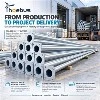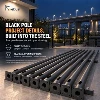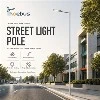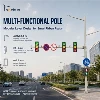

Octagonal steel lighting poles dominate roadway lighting, solar streetlight installations, high-mast floodlighting, smart city multi-functional poles and plaza illumination projects across global export markets. Their eight-sided geometry delivers superior torsional stiffness and reduced vortex-induced vibration, yet structural safety and service life do not rely solely on steel grade and sectional design. The surface protection specification is equally critical, and buyers repeatedly face a core decision: plain hot-dip galvanized finish, standalone powder coating, or the duplex system combining both. Many procurement teams mistakenly treat them as interchangeable decorative options, but each finish operates by a fundamentally different corrosion mechanism, carries distinct failure modes, and fits different environmental classes, budget cycles and maintenance regimes. For tender documents, factory inspection checklists and long-term asset management, clear specification language prevents underperformance, premature rusting and costly warranty disputes.

Hot-dip galvanizing (HDG) is a metallurgical process in which the fully fabricated octagonal pole, including internal cavities, weld seams, access door frames and base plates, is immersed in molten zinc at around 450°C, forming intermetallic zinc-iron alloy layers bonded permanently to the steel substrate, normally built to ISO 1461 or ASTM A123 standards. Its greatest technical advantage is sacrificial cathodic protection. If scratches, impact dents or field cuts expose bare steel, the surrounding zinc corrodes preferentially, stopping rust propagation across the damage zone. Unlike membrane coatings, galvanizing also protects the inner wall of hollow octagonal shafts, an often overlooked advantage because condensation, rainwater and humid air continuously enter through cable holes and joint gaps, where external-only coatings cannot reach. In remote rural roads, inland industrial zones and low-aesthetic-priority highway corridors, plain hot-dip galvanized poles offer excellent total cost of ownership. Properly galvanized Q235 or Q355 octagonal poles can deliver 25 to 40 years of service with minimal intervention in moderate atmospheric conditions, and they remain the default standard for many African, Middle Eastern and South American infrastructure tenders where on-site maintenance crews are scarce.
That said, plain galvanized finishes have obvious limitations that buyers must recognise. The natural silver-grey zinc surface gradually develops a dull matte patina and may form white zinc corrosion product, commonly called white rust, in high-humidity, marine or de-icing salt environments. Colour selection is effectively absent; the industrial zinc appearance conflicts with landscape roads, commercial districts, scenic waterfronts and urban renewal projects where architects require consistent RAL colours, matched street furniture and a clean uniform silhouette. Galvanized surfaces also have higher surface roughness, making them more prone to trapping dust and grime. While the corrosion performance is robust, the aesthetic ageing effect often becomes unacceptable for city centre projects within just a few years.
Powder coating, by contrast, is a dry electrostatic finishing method. Charged polymer powder adheres to the grounded metal surface, then cures in an oven at elevated temperature to form a continuous, tough organic barrier film, usually polyester powder with dry film thickness controlled between 60 μm and 120 μm for outdoor lighting infrastructure. Its biggest strength is aesthetic flexibility. Buyers can specify almost any RAL colour, matte, semi-gloss or textured finish, supporting coordinated urban design schemes. A properly cured polyester powder coat resists abrasion, graffiti cleaning and minor chemical exposure, and the smooth closed surface is easier to wash and keep clean. It contains no volatile organic solvents, making it an environmentally compliant finishing route for regions with strict emission controls. However, powder coating works purely as a barrier layer. If the film chips, cracks or delaminates from poor surface preparation, moisture penetrates directly to the bare steel underneath, and rust spreads rapidly beneath the coating, often blistering the finish outward before corrosion is visible from outside. This risk is severe if powder is applied directly over raw steel without galvanizing; standalone powder coating on ungalvanized octagonal poles is rarely recommended for long-life outdoor lighting, especially coastal or tropical projects.
This leads to the duplex system: hot-dip galvanizing first, followed by carefully prepared powder coating on top. This hybrid specification combines the sacrificial zinc protection of HDG with the colour retention, UV stability and barrier performance of polyester powder, and it is rapidly becoming the preferred choice for high-end municipal, waterfront and landmark lighting projects. Yet duplex systems are not simply "galvanize then spray powder"; poor sequencing or surface preparation is the most frequent source of factory defects. Fresh galvanized surfaces carry residual zinc ash, flux residue and a reactive zinc oxide layer. Without controlled weathering, sweep blasting or chemical conversion treatment before powder application, the organic coat will suffer poor adhesion, leading to peeling and flaking within just a few years. Responsible buyers must add these preparatory steps explicitly to the technical schedule, alongside powder qualification standards such as Qualicoat Class 1 for exterior durability, and salt spray testing requirements aligned with ISO 12944 corrosion categories from C3 inland to C5-M marine coastal environments.

To build practical specification rules, buyers should match the finish to site risk factors. Select plain hot-dip galvanized octagonal poles for remote highways, solar farm perimeter lighting, rural access roads and budget-constrained projects where visual appearance is secondary and long maintenance intervals are required. Specify standalone powder coating only for covered semi-outdoor locations or low-corrosion indoor applications, and avoid it for exposed steel street poles. Choose the galvanized-plus-powder duplex finish for city streets, waterfront promenades, tourist scenic zones, commercial plazas and smart multi-functional poles carrying cameras, routers and sensors, where both corrosion safety and uniform colour appearance are mandatory. For coastal projects with salt spray or regions using road de-icing chemicals, duplex systems with higher zinc mass and UV-resistant powder are strongly preferred over either single finish.
Buyers should also avoid vague wording in purchase orders. Instead of "anti-rust treatment", write exact standards: HDG to ISO 1461, minimum zinc thickness according to steel wall thickness; for duplex, state pre-treatment method, powder type, DFT range, gloss retention requirement and minimum salt spray test hours. They should also align the finish specification with pole type: one-piece octagonal poles are easier to galvanize uniformly, while sectional slip-joint poles demand extra attention to joint mating surfaces, as trapped moisture under powder-coated slip joints can trigger hidden corrosion if drainage is not designed in. Lighting performance from Dialux simulation remains unaffected by surface finish, but coating quality directly controls how long the pole structure stays safe and visually acceptable through windstorms, monsoon seasons and decades of UV exposure.
In summary, hot-dip galvanizing protects steel from the inside out through sacrificial action, while powder coating delivers colour and surface barrier protection. The duplex system merges their strengths, yet it requires tighter factory quality control and higher upfront cost. The best specification is not universally premium; it is the one calibrated to corrosion class, aesthetic requirements, local maintenance capacity and project design life. By clearly defining coating sequence, standards and inspection tests at the tender stage, buyers can avoid accepting visually attractive but structurally vulnerable powder-only poles, or durable galvanized poles that fail urban landscape acceptance criteria, and deliver octagonal lighting poles that remain safe and compliant throughout their design service life.