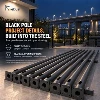

Many global EPC contractors, municipal buyers and solar lighting purchasers assume that once a street light pole is fully welded, galvanized and powder-coated, all components share identical coating quality. At Phoebus Lighting, with more than 25 years of steel pole manufacturing experience and an in-house QC team of 5 dedicated quality engineers, we have repeatedly found that base plates (flange plates) and pole shafts require independent coating inspection workflows, even when they are welded into one assembly. Combining their quality checks into one sampling process creates hidden corrosion risks that may only emerge years after site installation, especially for our projects delivered to over 126 countries worldwide.
 Our street light poles are fabricated from premium Q235B / Q355B steel, adopting duplex anti-corrosion treatment: hot-dip galvanizing followed by pure polyester powder coating, a standard we apply across conical, octagonal, square and high mast poles produced in our 62,000 ㎡ smart factory. Even with the same surface treatment line, the pole shaft and base plate face completely different mechanical stress, environmental exposure and manufacturing challenges.
The pole shaft sits above ground, resisting wind bending load, continuous UV radiation, rainfall and airborne dust. Its main coating defects include pinholes, uneven powder thickness and scratches generated during lifting and container loading. Our QC team uses visual inspection plus random dry film thickness testing for shaft sections; for most regions, powder coating thickness is controlled between 60–100μm, while zinc coating reaches ≥85μm, matching our published product specifications.
By contrast, the base plate sits at the critical soil-air transition zone after installation. Once fixed onto concrete foundations, flange surfaces are exposed to trapped condensation, road salt splash, soil moisture and stagnant water around anchor-bolt cutouts and weld seams. The weld zone connecting shaft and flange is the highest-risk spot: welding heat locally damages the zinc alloy layer and forms micro-porosity that is easily overlooked during a general full-pole visual check. For coastal, high-salt or tropical humid projects that we frequently support for African and Southeast Asian clients, this tiny coating flaw can rapidly develop into rust and compromise the whole pole's structural safety.
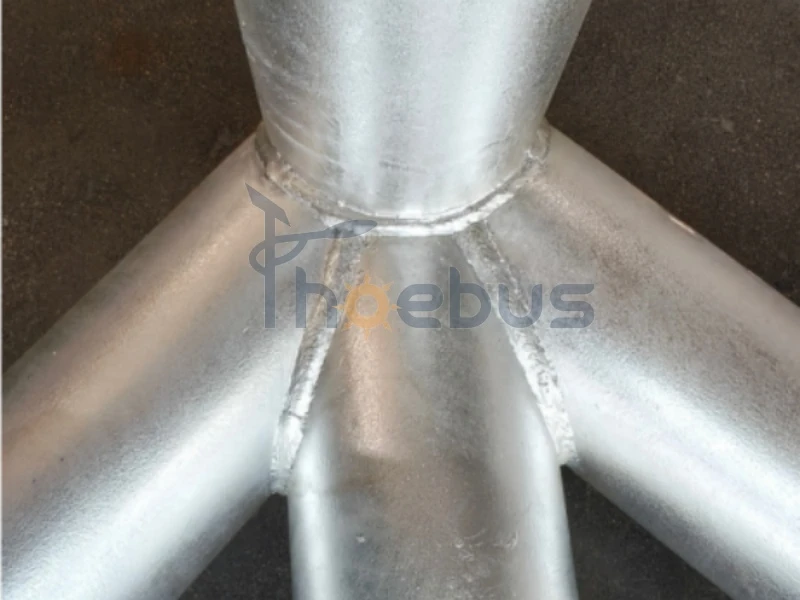
Manufacturing variance also makes unified inspection unreliable. Base plates are thicker, heavy-gauge steel cut and welded onto the pole body. They trap heat differently during galvanizing and electrostatic spraying, with more dead corners and overlapping weld areas. At Phoebus Lighting, we run separate inspection checklists for these two parts:
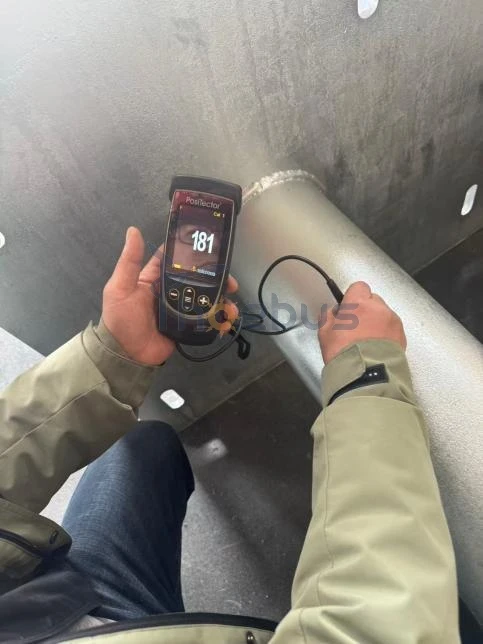
Pole shaft: focus on surface uniformity, UV resistance, scratch adhesion and thickness sampling along the full height;
Base plate & welding flange: mandatory full visual scan, zinc/powder thickness testing on weld seams, holiday pinhole detection, and batch salt spray verification for corrosive environments.
This separate inspection rule is built into our ISO9001, CE and SGS quality control system. Unlike many factories that only inspect finished poles as a single unit, our workflow checks raw flange plates before welding, rechecks galvanizing coverage after welding, and performs independent coating tests for base plates and pole shafts before packing. This strict process helps us deliver poles with a designed service life of up to 20 years and reduce after-sales corrosion complaints for our municipal, solar street lighting and high mast tender projects.
For procurement teams, it is a simple but vital specification point: ask your lighting pole supplier to provide separate coating inspection reports for base plates and pole shafts, rather than a combined single test certificate. This small detail avoids premature corrosion failure and protects the long-term value of your outdoor lighting investment.